


How Key Fobs Communicate: Complete Car Key Signal Guide
Ten seconds later, on pressing a button from 20 metres away, your car locks. The boot opens with another click. Press and hold and the windows drop. It takes place in no time and no apparent linkage between the fob and the vehicle. For most drivers, this is a miracle that they don’t even notice. Knowing how the keys “talk” to your car is a valuable piece of information, particularly when it fails to work and you have to determine if the problem is with the fob, the car or both fob and car. This is the complete guide to the subject from scratch.
Basic Principle Behind Key Fob Communication
The key fob method is based on the basic principle of key fob communication. Key fob communication is based on a simple principle.
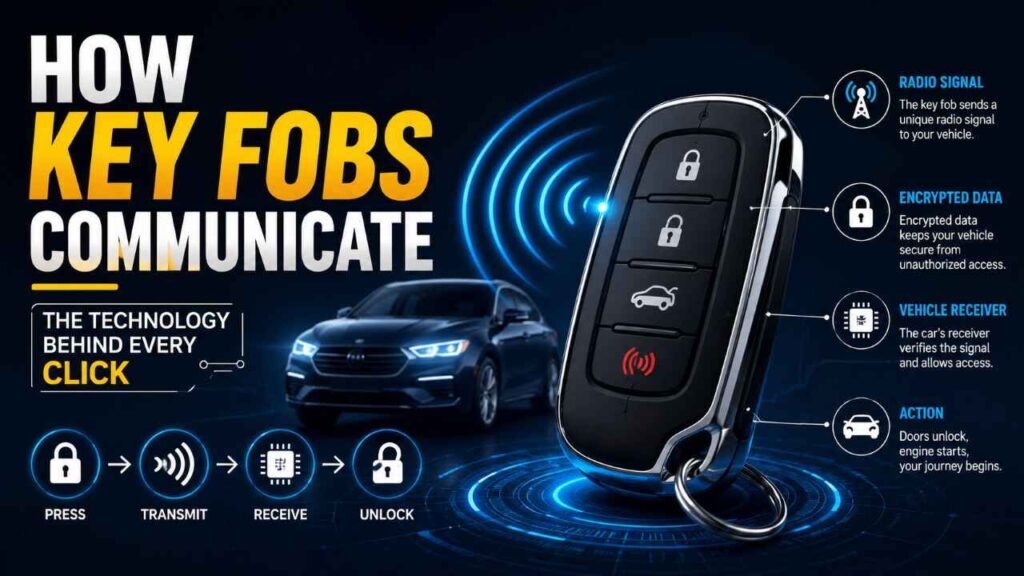
The key fob is actually a miniature radio transmitter. The fob sends out a radio frequency signal when it’s pushed and sends out the signal. The receiver is tuned to the same frequency that your car can receive, and when it receives the signal, it decodes the information in it and takes the appropriate action. The entire exchange lasts for a fraction of a second, and occurs wirelessly, without any direct connection between the two devices throughout the exchange.
Most key fobs function at 315 MHz in North America and 433.92 MHz in the rest of the world. They are low power radio frequencies and have sufficient range for normal use, typically 20 to 50 metres depending on the fob and the environment, without the need for any licensing or infrastructure to be put in place.
Understanding how key fobs communicate at this basic level already explains a few common problems. Radio signals can be blocked by certain building materials, interfered with by other devices operating on similar frequencies, and weakened significantly by a low battery in the fob. When your fob suddenly stops working well in a specific location, radio interference from the environment is often the actual cause rather than anything wrong with the fob itself.
Rolling Codes and Why They Matter
Original key fobs had a pre-programmed code. Whenever the button was pressed, the fob sent the same code, and the car recognized it. This functioned, but there was an obvious security issue. The signal from the fob could be recorded by anybody with the proper equipment and then played back at a later time, allowing the car to unlock. This sort of attack was both actual and it did happen.
Modern key fobs get around this with rolling code or hopping code. The algorithm and synchronised counter are not the same code to be sent every time but both the fob and the car have the same algorithm and synchronised counter. When the button is pushed a new number is generated depending upon the position of the counter. The car receives the code, performs a count and makes a comparison. It does, the car reacts. Afterwards, the fob and car move their counters forward to ensure the next legal code is not the same.
This will ensure that each time a button is pressed, a code is used that has never been used before and will never be used again. The basic means of recording and replaying the signal doesn’t work because when you replay a captured code, the car’s counter has moved past it and the replayed code is not valid. The secure communication between key fobs and modern vehicles is essential and integral to this.
What Happens When Fob and Car Fall Out of Sync
Rolling code systems are great when everything is as it should be but they have one problem. If the fob sends the codes out quicker than the car receives them, the counters can become misaligned. When you press buttons on the fob continuously while it’s out of the car’s range. Each press increments the fob counter but the car doesn’t get any signal, so its counter remains the same.
Most systems have a tolerance window, the car will accept codes if they are a few steps ahead of where the car’s counter is, which handles normal scenarios of a few missed presses. However, if the distance between the counters exceeds, the car will no longer accept any codes from the fob. This is a synchronisation failure and will cause the button to be unresponsive when pressed as in the case of a flat battery or broken fob.
The fix for a synchronisation loss is reprogramming rather than a battery change or a new fob. A locksmith with the right equipment can resync the fob to the car’s receiver and restore normal communication.
The Transponder Layer: A Separate Communication System
Here is something a lot of drivers do not realise. The remote locking function of a key fob and the ignition immobiliser function use two completely separate communication systems. Understanding how key fobs communicate properly means understanding both of them independently.
The remote locking radio signal handles locking, unlocking, and any other button functions. This is the active transmission that only happens when you press a button.
The transponder system is different. The transponder is a small chip embedded in the key fob or in the head of a key. Unlike the radio transmitter in the fob, the transponder has no battery of its own. It is a passive device. When you insert the key into the ignition, a coil of wire around the ignition barrel generates a low frequency electromagnetic field. This field induces a small electrical current in the transponder chip, which uses that induced current to power itself and transmit its unique identification code back to the ignition coil reader.
The car’s ECU receives the transponder code and checks it against the code or codes it has stored. On matching, the immobiliser unlocks, and the engine is able to start. When the code fails to match or no transponder signal is received, the code is checked by the engine management system, which prevents engine start even if the key is physically turned in the keyhole.
It’s possible to have a key fob that has a radio transmitter working fine for locks, but a dead or mis-matched transponder chip and then the car will lock and unlock fine from the key fob buttons, but not start when you put the key in the ignition. These are two separate systems and each may fail on their own.
Smart Key Communication: Always On
Unlike the normal key fobs, smart keys are unique – or proximity keys, or intelligent keys.
A normal key fob will only send a signal when a button is pressed. A smart key is always “talking.” Your car generates a low frequency signal in a short range field around the car, usually no more than about a metre away from the door handles. If a valid smart key is inserted into that field, it emits an ultra high frequency signal containing its code. The car validates the code and lets you in.
The continual two-way data traffic is what makes it possible to realize keyless entry and push button starting. You approach the car with the key in your pocket, the field reads the key, you put your thumb on the door handle and the door unlocks. You enter, press start, the car senses the key has been placed in the vehicle and the engine starts. No need to press a button at any stage.
The always on nature of smart key communication has its own vulnerabilities. Relay attacks exploit this by using two devices to amplify and extend the range of the car’s field into your house and simultaneously extend the range of the smart key’s response signal back to the car. The car thinks the key is nearby and unlocks. Understanding how key fobs communicate in this context explains why keeping smart keys in a signal blocking pouch when at home is a sensible security measure.
Why Battery Level Affects Communication Range and Reliability
The radio transmitter in a key fob has an optimum operating voltage to function at the intended power level. The transmitter power decreases and the range of the signal decreases as the battery fades. If it works at 5 metres but not at 20 metres, it is almost certain to have a low battery and not any other fault.
After the battery is depleted to a point the transmitter no longer sends any signal, the fob will appear to be completely dead. In this instance, it is a matter of fitting a fresh battery of the right type which will restore function immediately. This is because the transponder chip uses the power from the ignition coil field and not from the battery of the fob, which is why the ignition can still function even if the fob locking function has stopped working.
How AZ Cars Locksmith Can Help
At AZ Cars Locksmith, understanding how key fobs communicate is fundamental to the work we do every day. Proper knowledge of both the radio transmission system and the transponder system means we diagnose faults accurately rather than guessing. Here is what we bring to every key fob job:
- Accurate Fault Diagnosis Across Both Systems: We test the radio transmission, the rolling code synchronisation, and the transponder communication separately to identify exactly where a fault lies. A fob that appears completely dead may have a flat battery, a sync issue, a failed circuit board, or a transponder fault, and each of these has a different fix. Getting the right diagnosis means you pay for the right repair rather than a series of attempts.
- Key Fob Reprogramming and Resynchronisation: When a fob has lost sync with the car’s receiver, we use professional automotive programming equipment to restore the pairing. This covers standard rolling code fobs, smart key systems, and proximity entry setups across most vehicle makes and models. Reprogramming is completed on site at your location in a single visit.
- Transponder Key Programming: When a new key fob needs its transponder chip programmed to your car’s immobiliser system, we carry the diagnostic equipment to do this for most makes and models. Correctly programmed transponder means the new key both operates the locks and allows the engine to start, with full testing before we leave.
- We repair and replace batteries, worn button pads, cracked cases, water damaged circuit boards, and broken antennae. If a fob is beyond repair, we provide and fully program a compatible fob in the same visit for your convenience and you will leave with the fob working.
- Unpredicted Loss of Mobile Locksmith Communication: If you don’t have the ability to communicate with your key fob or if it becomes unresponsive, you may be locked out of your vehicle or unable to start your vehicle. We have a mobile crew available 24 hrs a day and can get to your site a quick as possible to fix the problem.
Why Choose AZ Cars Locksmith
When you need help with any key fob communication issue, here is what makes AZ Cars Locksmith the right team to call:
We Understand Both the Radio and Transponder Systems: A lot of locksmiths handle one side of key fob work well but are less confident with the other. Our team properly understands how key fobs communicate across both the remote locking system and the immobiliser transponder system. That complete knowledge means we diagnose correctly the first time and recommend the right fix rather than working through possibilities at your expense.
Professional Programming Equipment for Most Vehicles: Key fob programming is not something that can be done with basic tools. We invest in professional automotive programming equipment that covers most major vehicle brands and models. When a fob needs syncing or a transponder needs programming, we have the right tool for the job rather than a generic device that works on some vehicles and fails on others.
Repair Before Replace as a Starting Point: Our first question with any key fob fault is whether it can be repaired rather than replaced. A battery change, a circuit board clean, or a button pad replacement costs a fraction of a new fob and solves the problem just as effectively when the fault is minor. We tell you honestly which option applies to your situation.
Genuine 24 Hour Emergency Service: We run a real around the clock mobile locksmith service. A call at any hour gets a real response and a fast dispatch. Fob failure does not wait for office hours and neither do we.
Upfront Pricing on Every Job: We give you the price before starting any work. Whether it is a battery change, a reprogramming job, or a full fob replacement with programming, you know the cost before we begin and that number does not change when the job is done.
Final Words
Understanding the communication process between key fobs and your car will put you in a real head start if something does go awry. The distinction between a flat battery and sync can be made. You know that your fob might work near but not far. You are aware that the remote locking and the ignition transponder are two different systems that can fail independently. You also know that relay attacks on smart keys are a serious threat to be safeguarded.
This knowledge assists you to accurately communicate fob issues, make informed decisions on repairs and not paying for the repairs if it is not the root cause of the problem.
Contact AZ Cars Locksmith
Your key fob is malfunctioning or isn’t working the way you think? Call AZ Cars Locksmith and we will come to you, test both radio and transponder systems, and let you know what is wrong and what should be repaired prior to performing any repair. Fix price in advance, work done on site (except very limited cases).
Call AZ Cars Locksmith right away for professional solutions to any key fob communication problems. Our mobile staff is on call all day, every day to be at your service and your vehicle’s service.
Phone: 602-586-5999
Book Online: Click Here